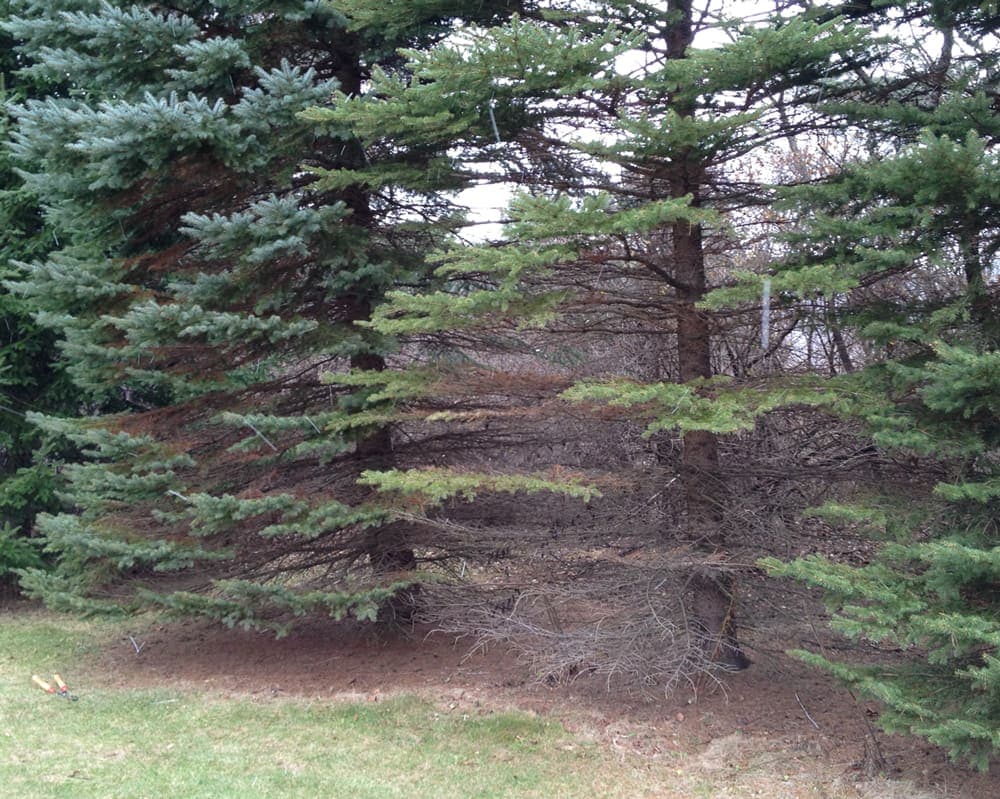
If your Blue Spruce has been losing needles from the bottom up — starting with the inner and lower branches and gradually working upward — Rhizosphaera Needle Cast is the most likely culprit. This fungal disease is the most common cause of needle loss in Colorado Blue Spruce throughout the Midwest, and it's frequently misdiagnosed as winter injury or spider mite damage.
What Is Rhizosphaera Needle Cast?
Rhizosphaera Needle Cast is caused by the fungus Rhizosphaera kalkhoffii. The fungus infects newly expanding needles in spring and early summer during wet, humid conditions. Infected needles initially remain green, then turn purple-brown the following fall and winter, and finally drop off the tree in spring — about 15 months after infection. This delayed symptom timeline means the disease is often well-established before homeowners recognize what they're dealing with.
How to Identify It
The most reliable diagnostic sign is the presence of tiny, black fruiting bodies (pycnidia) visible in the stomatal rows of affected needles. These look like rows of black dots under a hand lens, usually emerging from the needle surface in a linear pattern. By the time needles turn brown and drop, these structures have already released spores that have infected the next season's needles.
Key distinguishing features:
- Needle loss starts on lower and inner branches and progresses upward and outward over multiple seasons
- Infected needles turn purple-brown in fall/winter and drop in the following spring
- Current-year needles at branch tips often remain green while older needles have dropped
- Tiny black dots (pycnidia) visible on brown needles under magnification
Treatment Protocol
Rhizosphaera Needle Cast is manageable, but treatment requires patience — recovery takes two to three years of consistent care, and no treatment can restore already-dropped needles.
Fungicide applications: Preventive copper-based or chlorothalonil fungicide sprays are applied in spring to protect new growth from infection. The first application typically occurs at or just before bud break, with a second application 3–4 weeks later during rapid shoot elongation. Timing these applications to Northern Illinois weather patterns is critical to success.
Improving air circulation: Dense plantings or shaded sites increase humidity around the tree, creating ideal conditions for fungal spread. Selective pruning to improve airflow, combined with removing crowding vegetation, can meaningfully reduce disease pressure over time.
Sanitation: Raking and disposing of dropped needles removes a portion of the inoculum available for the next season's infections.
Irrigation management: Avoid overhead watering, which wets needles and extends the leaf wetness period that allows spore germination. Drip irrigation directed at the root zone is preferred.
When to Seek Professional Treatment
The time to start Needle Cast treatment is in early spring, before new growth begins to emerge. If your Blue Spruce has been thinning from the bottom up for more than one season, it's time to call in a certified arborist. Tree Care Enterprises serves Rockford, Machesney Park, Loves Park, Rockton, Belvidere, and surrounding areas throughout Northern Illinois and Southern Wisconsin.
Call Tree Care Enterprises at (815) 965-5757 to schedule your Blue Spruce health assessment.