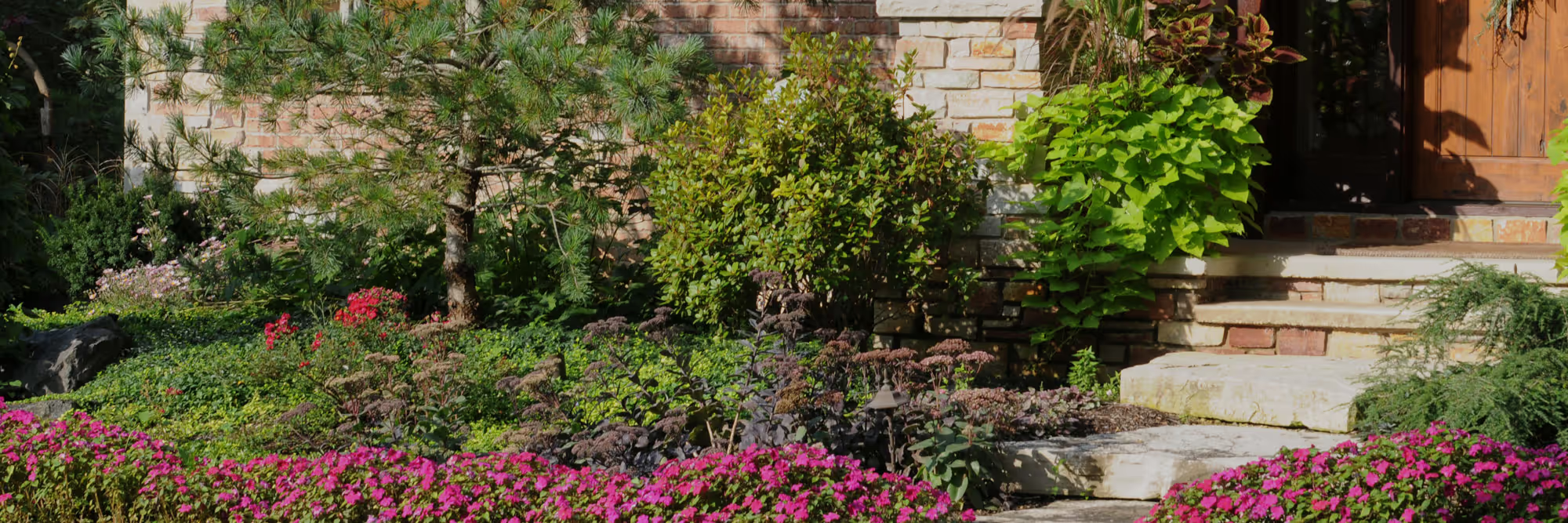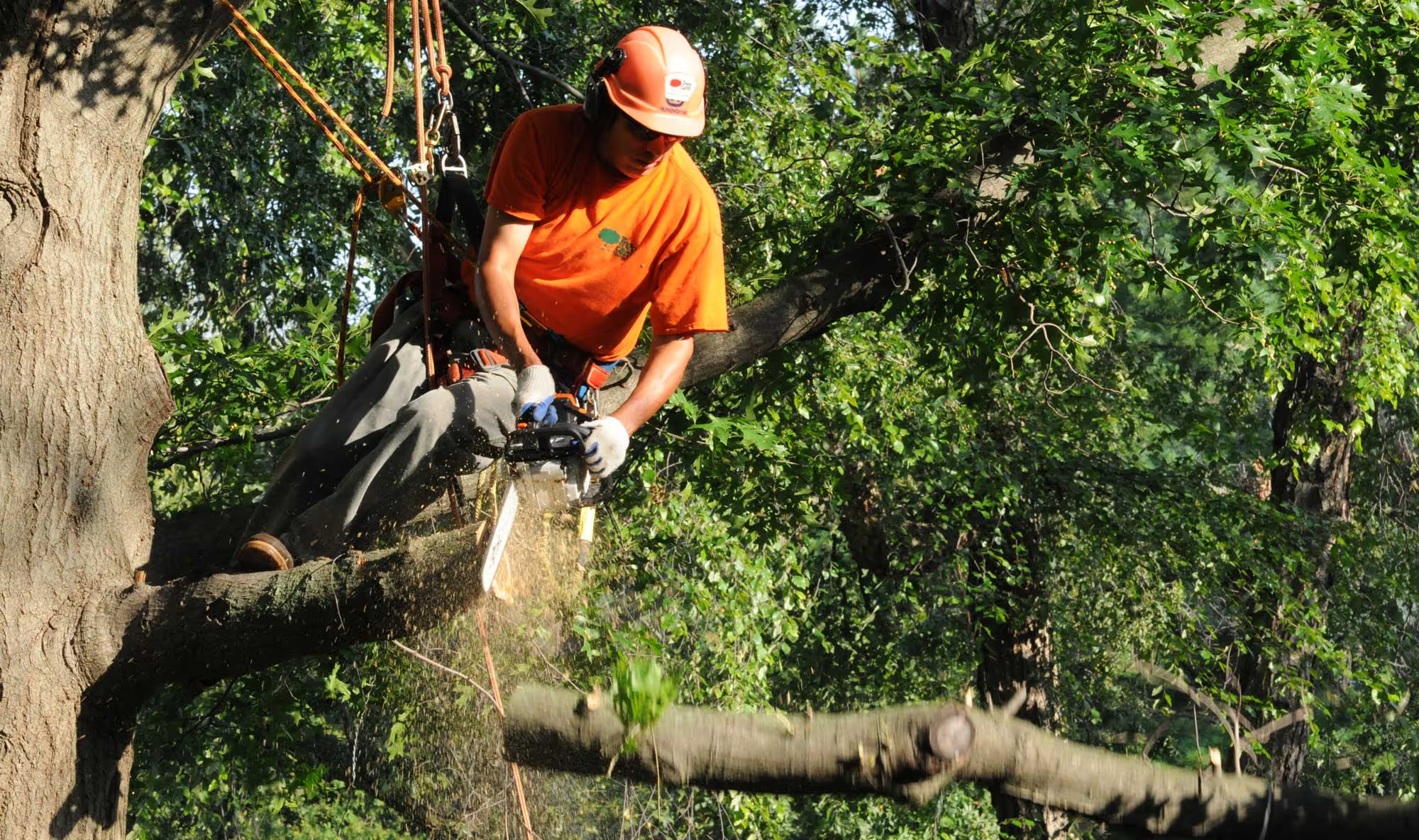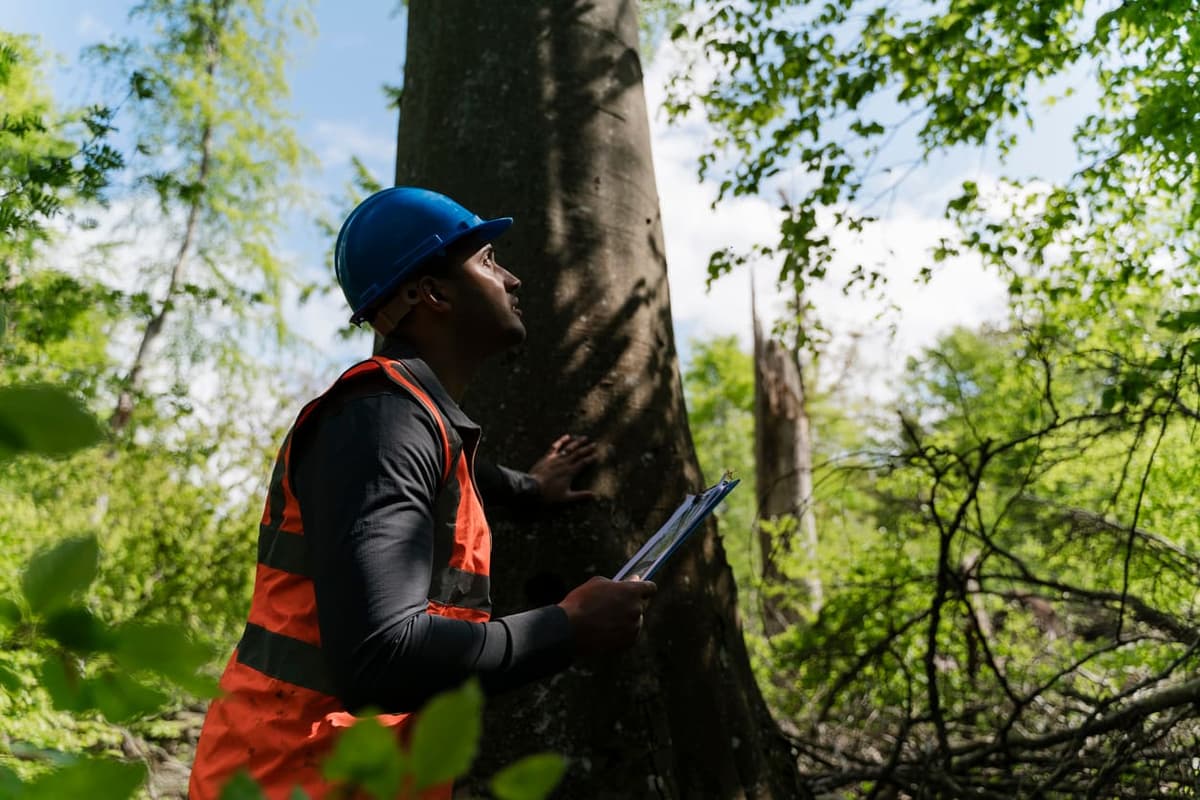
A 120-year-old bur oak has roots well beyond the spot where you want to build a patio. Excavation, grading, and heavy equipment can damage those roots while leaving the trunk untouched. Protecting the tree starts with the plan.
This guide covers what kills oaks during landscape projects, how to design around mature oaks instead of against them, and the practical decisions that determine whether your hundred-year-old tree survives the patio installation.
Why Oaks Are Especially Vulnerable
Most landscape damage to mature trees happens during construction. Oaks are more sensitive than most species because of three biological facts:
-
They evolved as forest-canopy trees with deep, structural root systems. Sever the structural roots and the tree slowly loses anchorage. It can stand for years before failing — usually catastrophically, in a storm.
-
They form mycorrhizal relationships with specific soil fungi that take decades to develop. Disturb the root zone soil and you disrupt the fungal network the oak depends on for water and nutrient uptake. Replacement soil from a nursery doesn't include the right fungi.
-
They're slow to show stress. A maple killed by root damage shows signs within 2–3 years. An oak killed by the same damage doesn't show terminal symptoms for 5–8 years. Most homeowners don't connect "I built a patio in 2020" with "my oak died in 2027."
This delayed-stress pattern is why oak kill-rates from landscape projects are higher than people realize. The tree dies; nobody attributes it to the work done five years earlier.
The Critical Root Zone
The "critical root zone" of an oak is the area its roots actively occupy. A common shorthand is 1 to 1.5 feet of radius per inch of trunk diameter at breast height. A 24-inch-trunk oak has a critical root zone roughly 30 feet in radius — a circle 60 feet across.
Most of those roots are in the top 18 inches of soil. They radiate outward, well beyond the visible dripline (the edge of the canopy), and they're surprisingly thin and fragile. Severing a single 3-inch structural root can compromise tree anchorage on one side.
This is the area where landscape work needs to be designed carefully. Inside it, almost any digging, compaction, or grade change has consequences.
What Kills Oaks During Landscape Projects
Six common mistakes account for the vast majority of construction-related oak loss in our experience.
1. Root severance during excavation
Trenching for irrigation, footings, or drainage cuts structural roots. A trench that's "only 8 inches deep" still cuts through the surface roots oaks depend on most.
Design solution: Route trenches outside the critical root zone where possible. Where routing is forced inside the CRZ, use radial trenching (lines that run away from the trunk, severing the minimum number of structural roots) instead of tangential trenching (lines that run perpendicular to the trunk, cutting many roots).
For irrigation specifically, consider air-spading trenches or surface-mounted drip lines instead of conventional trenching within an oak's root zone.
2. Soil compaction during construction
Heavy equipment driving over the root zone compacts soil and crushes feeder roots. A single pass of a Bobcat is enough to permanently compact the top 6 inches of clay.
Design solution: Stake out a tree protection zone around mature trees BEFORE construction starts. Restrict equipment traffic to designated paths protected by mulch beds or plywood. The cost of staging equipment carefully is trivial compared to losing a mature tree.
3. Patio installation within the root zone
Paver patios in particular are deadly to oaks because the standard installation involves:
- 6–10" of excavated material removed (severs surface roots)
- 6–10" of compacted aggregate base installed (crushes remaining roots, prevents oxygen exchange)
- Polymeric sand seal (further reduces soil gas exchange)
The end result is that the soil under the patio becomes uninhabitable for oak roots. The oak's root system loses 20–40% of its active surface area depending on patio size and location.
Design solution: Locate patios outside the critical root zone wherever possible. Where the design pulls the patio inside the CRZ, consider:
- Pier-supported decks instead of patios — deck framing on minimal foundations preserves the soil and oxygen exchange.
- Permeable pavers with reduced base depth — engineered to allow water and air infiltration. Not zero impact, but significantly less than standard impermeable installations.
- Suspended pavers on pedestals over a permeable base — used in commercial work, applicable to high-end residential.
- Reposition the patio. Most often, the right answer is to move the patio 10–15 feet to put it outside the CRZ entirely.
4. Grade changes: adding soil over roots
Adding more than 2–3 inches of soil over an oak's root zone smothers the surface roots that depend on direct gas exchange with the atmosphere. Many landscape projects bury oak root flares under decorative grade changes — and the oak responds by declining over the following 5–10 years.
Design solution: Never grade over an oak's root zone. If grade changes are required for the design (patio elevation, drainage), use retaining walls outside the CRZ to manage the grade transition rather than burying it under fill.
5. Trenching irrigation under the canopy
Conventional pop-up irrigation requires trenched poly pipe, often 12 inches deep, often running radially or tangentially through the root zone. This combines root severance with soil compaction in one operation.
Design solution: Mature trees don't need irrigation once established (and watering established oaks too much is actually harmful — root rot, fungal disease). Where the design requires irrigation in beds within the CRZ, use surface drip lines instead of trenched poly. Pinned to the soil surface, no trenching, no root damage.
6. Volcano mulching
Piling 6+ inches of mulch against the trunk and over the root flare creates a moist environment that rots bark and harbors pathogens. The oak girdles itself over time. Common, lethal, completely preventable.
Design solution: Mulch the root zone in a 3–4 inch layer kept several inches away from the trunk. Expose the root flare so you can see where it meets the soil. "Donut, not volcano."
Design Principles for Oak-Centered Landscapes
Rather than designing AROUND an oak as an obstacle, the best approach is to design WITH the oak as the central feature. A few principles:
Make the oak the anchor
Use the oak as the visual center of the design. Sight lines from the house should frame it. Outdoor seating areas should reference it. Lighting should uplight it dramatically at night. Treat it as the most valuable element on the property because it is.
Plant compatibly underneath
Most lawn grass is hostile to oaks — competes for water, requires more irrigation than the oak prefers, requires fertilizer the oak doesn't need. Replace turf under oaks with shade-tolerant native groundcovers:
- Pennsylvania sedge (Carex pensylvanica) — native sedge that forms a lawn-like layer
- Wild ginger (Asarum canadense) — native groundcover
- Christmas fern (Polystichum acrostichoides) — evergreen native fern
- Foamflower (Tiarella cordifolia) — flowering shade groundcover
- A 3-inch mulch ring kept away from the trunk
Lift the canopy strategically
Selective crown raising — pruning the lower limbs up to 12–15 feet — opens sight lines and creates usable space under the canopy without harming the tree. Best done in late fall through winter when oaks are dormant. Critical: never prune oaks April through September in northern Illinois due to oak wilt vector season.
Light from below, not above
Low-voltage uplighting placed beyond the root zone (or pinned at the soil surface within the root zone — no trenching) dramatically improves an oak's nighttime presence. Avoid in-ground fixtures that require trenched conduit through the CRZ.
Use the oak's natural drip line as a design boundary
Hardscape, planting beds, and irrigation should all respect the dripline as a default boundary. Inside the dripline, every design decision needs justification. Outside it, you have more flexibility.
Working With an Arborist on Landscape Projects
The single most important decision when designing a landscape around mature oaks is whether the design firm has actual arborist expertise — or treats the trees as obstacles to design around.
Tree Care Enterprises is unusual in northern Illinois landscape design-build in that we're operated by ISA Certified Arborists. The same firm that designs your patio and walls has seven credentialed arborists on staff, and an arborist consults on every design decision near a mature tree. That's not standard practice in landscape contracting; in most cases, the design and the tree-care expertise are separate, and the design wins by default — usually at the tree's expense.
If you're working with a different firm, the practical equivalent is hiring a consulting arborist (ISA Certified, ideally TRAQ-qualified for tree risk assessment) to review the landscape design before construction starts. The consulting fee — typically $300–$1,200 for a residential project — is far less than the cost of replacing a mature oak or worse, losing it without replacement.
What to Ask Before Construction Starts
If you're working with any landscape firm on a project that touches your mature trees, the questions worth asking:
- Have you identified the critical root zone of each mature tree on the property? A "yes" without a clear explanation is a red flag.
- Where will equipment stage and travel during construction? "We'll figure it out" is not an answer.
- What protection is in place to prevent root zone compaction? Stakes and rope are the minimum; mulch beds or plywood ground protection are better.
- How will trenching be routed relative to my mature trees? They should be able to walk you through specific routing decisions.
- Will you adjust the design if construction encounters something unexpected? A good firm will. A bad firm will dig through and tell you afterward.
- What happens if a mature tree shows decline within 5 years of construction completion? Most firms have no answer. Better firms offer a tree-health monitoring window post-construction.
When Removal Is Honestly the Right Answer
Sometimes the existing oak is genuinely past saving — structural decay, advanced disease, severe storm damage. In those cases, integrating removal with the landscape redesign is appropriate. What's not appropriate is silently building around a doomed tree, having it die two years later, and treating the removal as a separate emergency.
If our arborists assess that the oak is in terminal decline, we'll say so during the design phase. You can then decide whether to remove and replant as part of the project, design around the eventual loss, or proceed with the design knowing the tree will need to come out within a defined window. Honest assessment beats wishful thinking.
Talk to a Designer-Arborist About Your Property
Call 815-965-5757 or request a free consultation to discuss a landscape project near mature trees. A designer with arborist consultation will walk the site with you and identify the constraints — and the opportunities — your trees create.
Related services: Landscape Design & Build, Tree Preservation, Tree Care.